
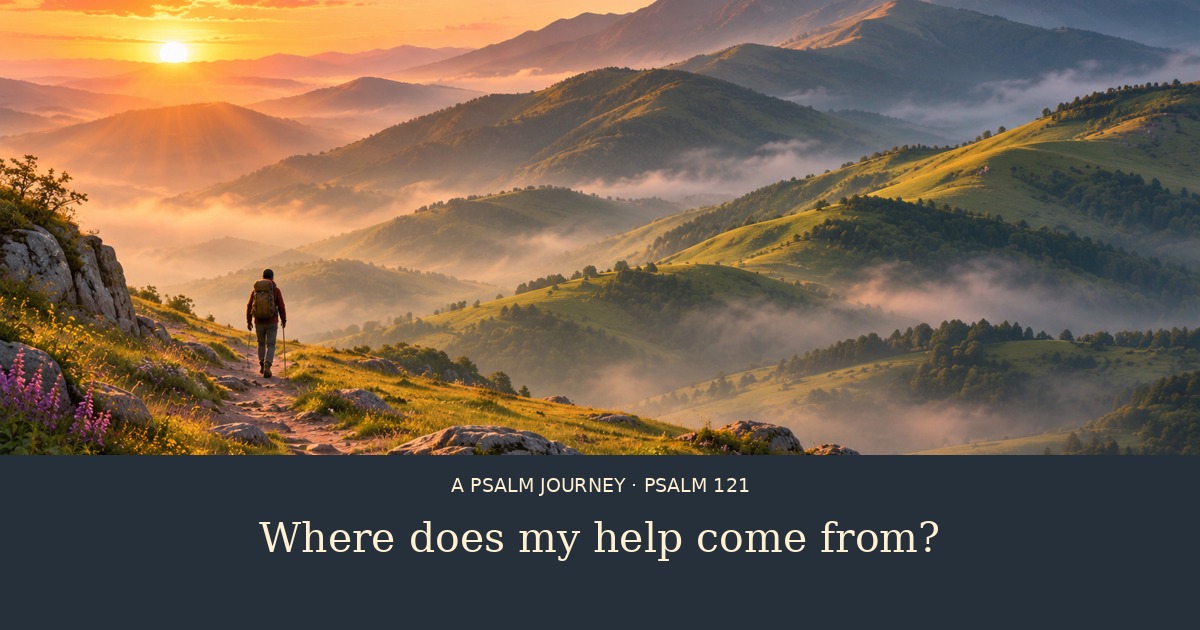
Psalm 121 begins with someone lifting their eyes toward the hills and asking where help will come from. It answers by naming the Lord, the maker of heaven and earth. That makes it a useful Psalm for a day when you know you need help but do not yet know what form it will take. You can pray it before a trip, before a difficult appointment, or on an ordinary morning when someone you love is beyond your reach.
Read the question before repeating the answer
Read the opening aloud. Notice that the Psalm makes room for the question. You do not have to begin prayer by convincing yourself that you are calm or sure. The speaker looks up and asks. If your thoughts are scattered, stop at that point and name what you are facing in one sentence. “I need help with a conversation I cannot avoid” is enough to start.
Then read the response. The speaker does not locate help in the hills themselves, even though that is where the eyes go first. The answer turns attention toward God as maker of heaven and earth. You might pray it as a contrast between the particular problem in front of you and the larger reality you cannot see all at once. This is not a demand to stop noticing risk. It is a way to ask where your confidence can rest while you make the next decision.
Notice the repeated picture of a keeper
As the Psalm continues, listen for its language of keeping and watching. A person on a journey cannot see every part of the road. The Psalm pictures a keeper who does not fall asleep. It speaks of exposure by day and by night and closes with the ordinary movement of going out and coming in. The protection it describes is not limited to one place where a person feels safe.
Try reading those images without turning them into a guarantee that nothing difficult can happen. The poem is a confession of trust, not an insurance policy. Prayer can sit alongside preparation, a call for practical help, or a reasonable change of plans. If you are about to travel, checking the route and saying a prayer belong together. You do not have to choose between attentiveness and trust.
Pray it before a journey or appointment
Take a moment before you leave. Read the first two lines of the Psalm, and then name the place you are going. You can pray, “God, you know the road ahead and the part I cannot see. Help me travel with care and receive help when I need it.” If you are going to an appointment, ask for the courage to say what needs to be said and the patience to listen to the response.

Choose one action after the prayer: put the appointment notes in your bag, send the arrival time to someone who needs it, or allow enough time not to rush. Let the action answer the part of the situation you can influence. The prayer does not have to provide a prediction about what will happen. You can stop after naming where you are going, what you need, and what you can do.
Pray for someone you cannot watch over
When the Psalm makes you think of another person, name them in prayer. You may be concerned about someone traveling, starting a new role, or waiting for news. It can be tempting to use the time imagining everything that might go wrong. Instead, make one specific request: that they have someone trustworthy nearby, that they find the words they need, or that they feel less alone while they wait.
Then ask whether there is a form of help you can actually offer. A message that does not demand an immediate reply might be welcome. So might checking in later rather than repeatedly asking for updates. If you do not know what would help, you can ask the person when the time is right. The distinction matters: caring for someone and controlling their circumstances are not the same. The Psalm gives you words to keep caring when your reach has limits.
Put one line in a Psalm journal
Write three short headings: “Where I am going,” “What I need,” and “What I can do.” The first may be literal or not. You might be going into a long day at work or into a period of waiting. In the second space, name the help you are asking for. In the third, record a small step that belongs to you. Leave the rest of the page open.
Here is one example: “I am going into a meeting that may be tense. I need help to listen without rushing to explain myself. I can prepare two questions and pause before answering.” You can write that much even if you do not have time for a full page. Later, return and record what actually happened. Do not rewrite the morning entry to make it sound as though you knew the ending.
Choose the Psalm for the moment you are in
Psalm 121 works well as a prayer for help along the way. Psalm 4 offers a different rhythm at bedtime, and Psalm 13 gives more room to voice the length of a difficult wait. There is no need to find the one perfect passage. Choose a Psalm you can read with attention. If quiet music helps, listen after the words rather than asking it to supply the feeling you think the prayer should produce.
Before you go out today, try this one question: “What help am I asking for, and what is mine to do next?” Read Psalm 121 once and let one line stay with you. For a longer rhythm of Scripture, reflection, and writing, explore A Psalm Journey. You can begin with this one Psalm and return when you need it again.